
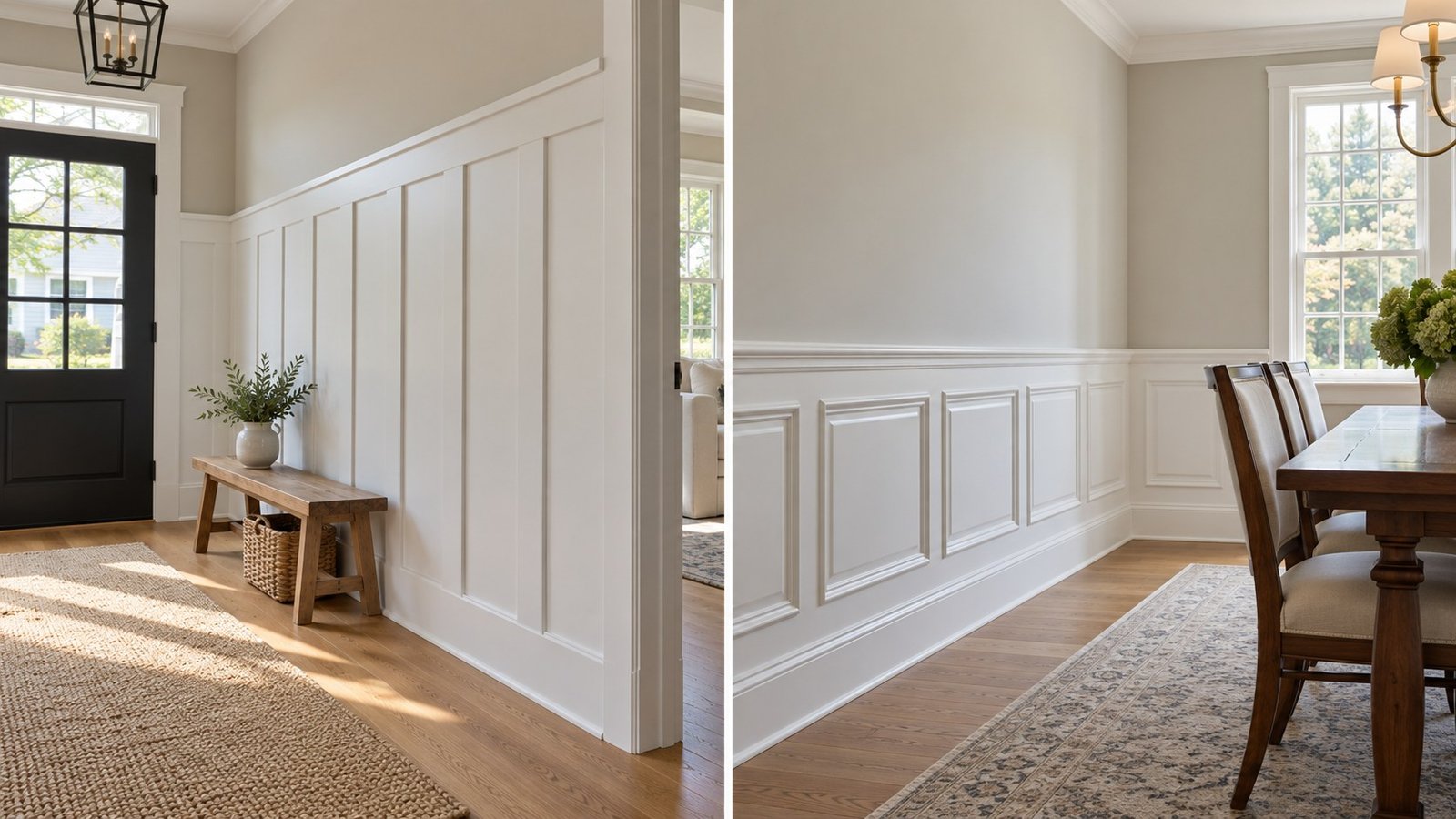
The Functional Purpose of Wall Paneling in New England Homes
Interior millwork in Massachusetts has always served a dual purpose: architectural structure and wall defense. In historic Boston row houses, North Shore Capes, and suburban Colonials, lower-wall treatments were originally installed to shield plaster from chair backs, boot scuffs, and daily wear while adding an extra layer of thermal buffer against cold drafts.
Modern homeowners often weigh board and batten vs. traditional wainscoting strictly on appearance, but durability and spatial scale matter just as much. The right profile protects drywall in narrow hallways, frames entryways, and establishes clear proportions in rooms with varying ceiling heights. Choosing between these two styles depends on your home's layout, existing moldings, and how each room is used.
Board and Batten: Clean Lines and High-Traffic Durability
Board and batten relies on flat vertical boards (battens) installed across wide interior panels or directly over prepared drywall. The top is anchored by a square cap rail, while the bottom ties directly into the baseboard. This creates an orderly, linear pattern defined by right angles rather than curved profiles.
Because it uses flat stock with minimal grooves, board and batten collects far less dust than ornate trim. That makes it a practical option for high-traffic zones like mudrooms, entry halls, and stair landings. Battens can be spaced closely (8 to 10 inches apart) for a structured look, or wider (12 to 16 inches) to match broader walls.
Board and batten also provides vertical flexibility. While standard wainscoting stays within the lower third of a room, board and batten can easily extend two-thirds up the wall or run floor-to-ceiling. In homes with standard eight-foot ceilings, running tall vertical battens draws the eye upward and makes rooms feel taller.
Traditional Wainscoting: Formal Proportions and Depth
Traditional wainscoting refers to panelized woodwork featuring shaped profiles, most commonly raised panel or recessed flat panel (picture frame) designs. It is bounded by a substantial baseboard at the floor and a detailed chair rail molding along the top edge, typically resting between 32 and 36 inches above the floor.
This style relies on depth and shadow. The beveled edges of raised panels reflect natural light across dining rooms, foyers, and formal living areas. In traditional New England interiors, this level of detail integrates seamlessly with classical features like multi-piece baseboards and modern crown molding.
Traditional wainscoting requires strict mathematical symmetry. Panels must be measured and built so that every section across a given wall remains equal in width, even when working around electrical outlets, baseboard heaters, and window casings.
Matching Wall Trim to Massachusetts Home Styles
Selecting the right profile requires looking at the era and architecture of your property:
Colonial and Victorian Homes: Traditional raised or recessed panel wainscoting fits the historical fabric of classic Boston Colonials and Victorian layouts in Cambridge, Brookline, and Somerville. These homes feature substantial casing profiles and formal room divisions, where simple flat boards can look undersized.
Cape Cods and Coastal Cottages: Board and batten complements the relaxed scale of Cape Cod homes on the South Shore and coastal properties across the North Shore. The clean geometric layout aligns naturally with lower ceilings without crowding the living space.
Suburban Modern Builds and Farmhouse Renovations: Board and batten remains the preferred choice for newer construction in areas like Burlington, Woburn, and Lynnfield. Its Shaker-style simplicity pairs well with flat-profile casings and contemporary solid-core interior doors.
Staircases and Multi-Story Entryways: Both styles function well on stairs, but the installation details differ. Traditional paneling requires complex angled panel cuts that align with stair risers, which is common during a full staircase remodeling project. Board and batten offers a cleaner transition from the first-floor foyer up to the second-story landing.
Carpentry Precision: Scribing, Expansion, and Layout
Massachusetts homes experience severe seasonal humidity shifts. Cold winters with indoor dry heat contract interior wood, while humid coastal summers cause it to expand. Poorly installed trim will separate at the seams, crack at the joints, or buckle off the drywall.
Professional installation starts with material acclimation and precise joint construction. Finish carpenters use scarf joints on long linear runs, coped corners instead of simple miters on inside edges, and adhesive fasteners driven straight into wall studs. In older Greater Boston houses, walls and floors are rarely plumb or level. Skilled carpenters scribe the baseboards and rails directly to the contours of the floor and plaster to prevent gaps before paint is applied.
Understanding these structural factors is essential when reviewing what to look for when hiring a finish carpenter in Massachusetts.
Wall Trim and Custom Carpentry by Green Dot Carpentry
Green Dot Carpentry brings over 20 years of hands-on finish carpentry experience to residential projects throughout Greater Boston. Led by Dinier de Oliveira and based in Revere, Massachusetts, our team specializes in custom wall paneling, board and batten, traditional wainscoting, interior doors, crown molding, and custom built-in woodwork.
We serve homeowners across a 30-mile radius, including Revere, Boston, Cambridge, Somerville, Malden, Medford, Lynn, and surrounding communities. Every installation is handled with professional discipline: our crew works in uniform, arrives on time, and maintains clean, orderly workspaces. When the carpentry work is finished, we remove dust, scraps, and debris so your home remains clean. We are fully insured, ensuring reliable, high-standard execution on every home improvement project.
Schedule Your Finish Carpentry Consultation
Adding custom wall paneling upgrades your home's interior durability and preserves structural surfaces from daily impact. Whether you are installing clean board and batten in a busy entryway or detailed traditional wainscoting in a formal dining room, precision measurement and expert installation make the difference.
Call Green Dot Carpentry today at (617) 888-5362 to discuss your project layout, schedule an on-site evaluation, and get a direct estimate for your Greater Boston home.